How does everything around us get made? People are deeply curious about how things come into being. Yet manufacturing, a key part of the design process, is often hidden from view. Christopher Payne’s photographs reveal the unique combination of human skill and mechanical precision that transforms raw materials into useful objects and systems.
Payne has spent more than 10 years photographing America’s factories, joining a lineage of photographers that includes Louis Hine, Alfred T. Palmer, and Gordon Parks, who also documented the American worker. Some of the factories rely on handcraft and have remained proudly unchanged over decades. In others, engineers and technicians work side by side with robots, pushing the limits of technology and collective intelligence—both human and artificial. Payne’s photographs celebrate the grace and craftsmanship of skilled makers and convey useful information about the complex machinery used in the making process.
Payne describes factories as places where people of varying ages and backgrounds come together to work toward a common goal. His images are windows into our industrial past and our technological future, from the New England textile mills that were among the country’s founding industries to the new plants for building microchips and quantum computers.
Through his visually arresting photographs, Payne documents a world of making and makers that continues to change at staggering speed. In celebration of the nation’s 250th anniversary, this exhibition brings together some of Payne’s most iconic images to consider the American factory as a key site of design ingenuity and innovation.
Made in America: The Industrial Photography of Christopher Payne
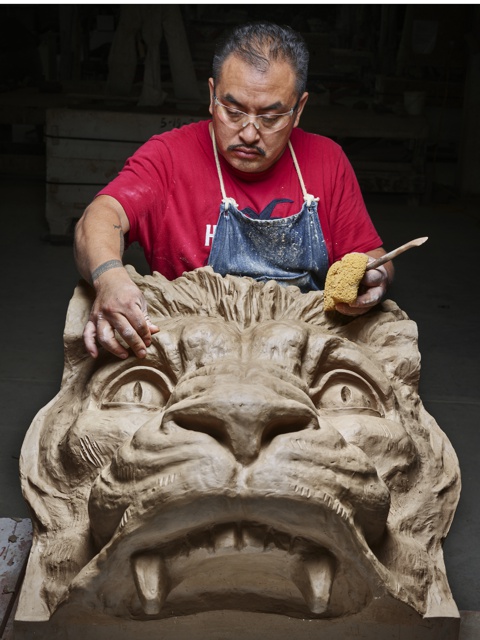
In the center of the photograph is an individual in a bright red shirt, clear protective goggles, and a dark blue apron covered in splatters of clay. At chest height they lean over a massive lion head wider than their body, unpainted and sculpted from clay. Their right hand is holding a damp yellow sponge and wooden carving tool, while their left hand pinches and smooths the brow of the lion facing the viewer.
Made in America: The Industrial Photography of Christopher Payne
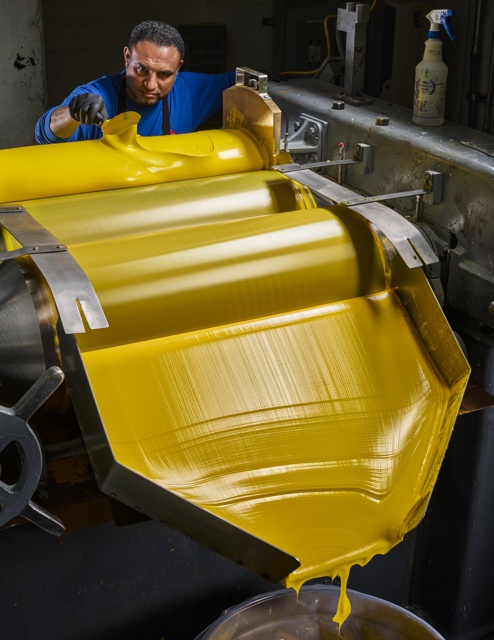
A large shiny silver machine moves hills of bright sunny yellow paint from background to foreground and into an open metal bucket at the bottom center. In the top right corner of the image, a worker who stands at chest height behind the paint wears a bright blue shirt and black gloves, staring intently while moving the paint with a tool shaped like a spatula. The background of the image is dark with bolts and wire for the machinery, and a spray bottle on a ledge in the top right.
Made in America: The Industrial Photography of Christopher Payne
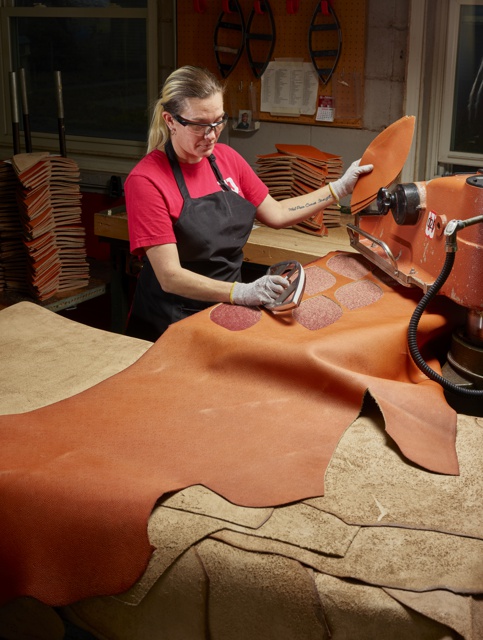
A woman stands in a red t-shirt, black apron, safety glasses, and grey gloves with her body angled to the right of the image. In front of her is a table at waist height covered in swatches of leather much larger than herself. Most swatches in the pile are light brown save for the very top one which is a warm reddish brown with a smooth finish. In her right hand is a silver metal tool shaped like an elongated football and in her left is the cut-out pieces of leather that will form the football, previously cut pieces are stacked behind her.
Made in America: The Industrial Photography of Christopher Payne
In front of a stark black background, a grey haired worker in a faded blue button up and blue jeans stands on the left of the image leaning back, with a long slim pole under their arm and a drum cymbal behind them. To the right is a large turquoise frame with a shiny brass cymbal in the center spinning on the lathe as the worker trims and shapes it, piles of shredded metal debris are strewn below.
Made in America: The Industrial Photography of Christopher Payne
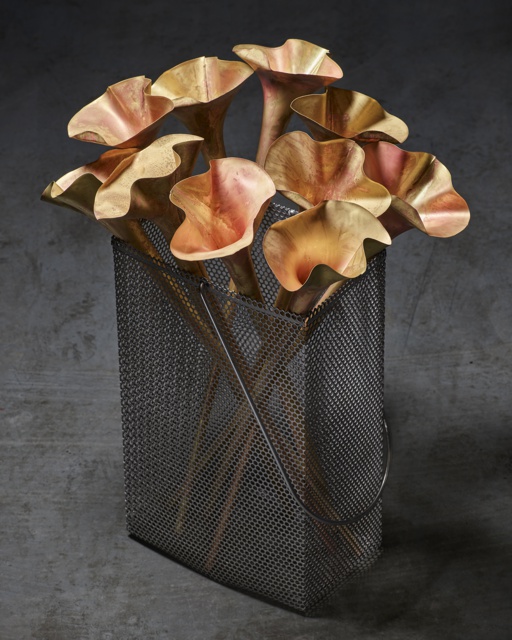
Centered in front of a dark metallic grey background is a rigid, vertically rectangular chicken wire basket with a thin, semi-ovular shaped handle. Inside the basket is an arrangement of ten trumpet flowers made of bronze. Their long tubular stems cross over one another in the basket before flaring into irregular waves towards the top.
Made in America: The Industrial Photography of Christopher Payne
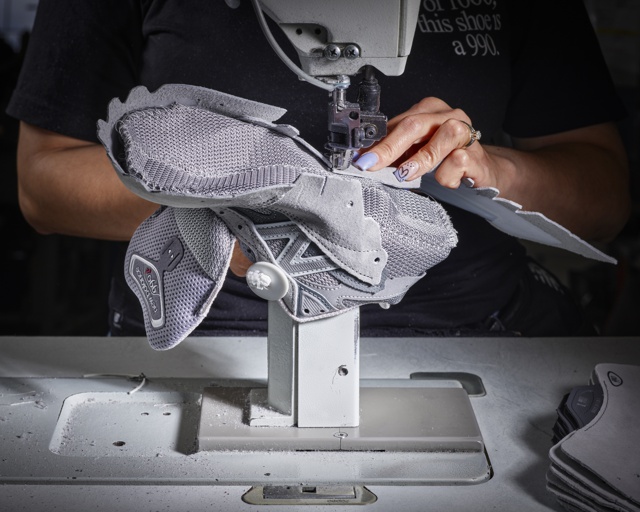
A medium grey running shoe firmly held on a similarly grey industrial sewing machine. The lip of the shoe curves up at the left and reads “New Balance 990.” The top half of the shoe is sewn to the bottom by an industrial needle in the top center of the photograph, while the material is carefully held together by two fingers.
Made in America: The Industrial Photography of Christopher Payne
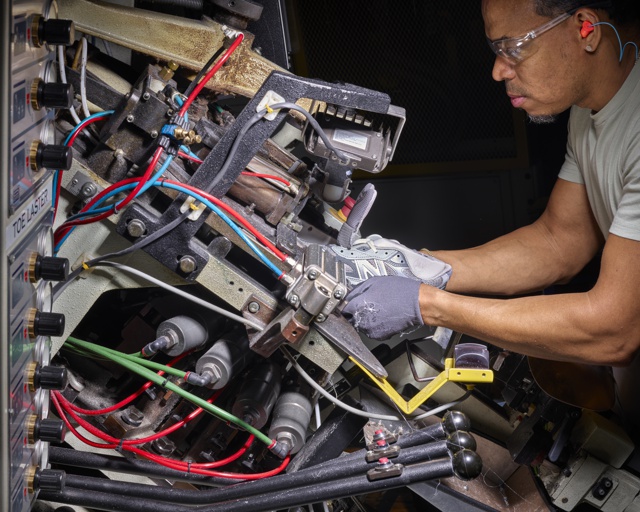
To the right a man stands in profile facing center, pressing a grey 990 New Balance running shoe under machinery the size of his torso that is riddled with bolts, levers, and colorful wires. He wears clear protective goggles and bright orange earplugs. Both man and machine stand out against a stark black background.
Made in America: The Industrial Photography of Christopher Payne
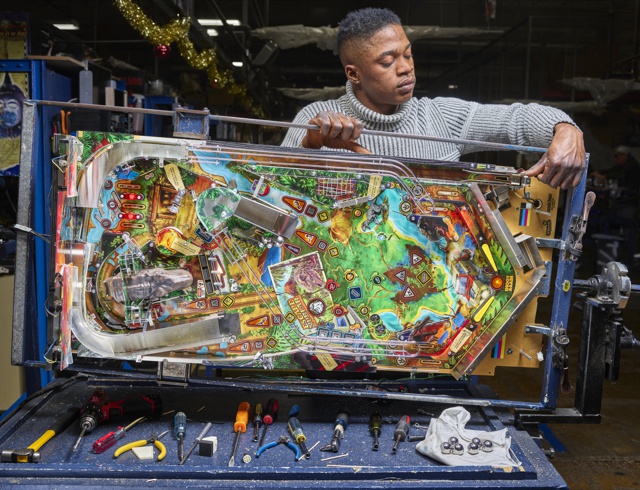
A pinball machine is turned on its side so the top is facing forward. The design shows land and rivers, dinosaurs, volcanoes, and a monster truck. The game is resting on a dark blue table with various tools laid out across the top including a drill, pliers, wrenches, screwdrivers, and six silver metal balls used in the game. Standing behind the machine, a worker in a grey turtleneck sweater holds the game in position with their right hand and tests one of the mechanisms with the other.
Made in America: The Industrial Photography of Christopher Payne
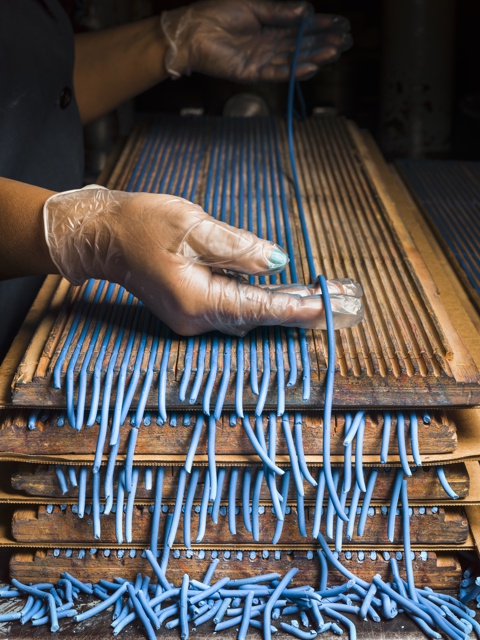
Two gloved hands lay a thin pastel blue rope into a wooden board with several other identical strands. The wooden board is stacked on top of four other uniform boards. A pile of pastel blue fragments sits at the base of the stack.
Made in America: The Industrial Photography of Christopher Payne
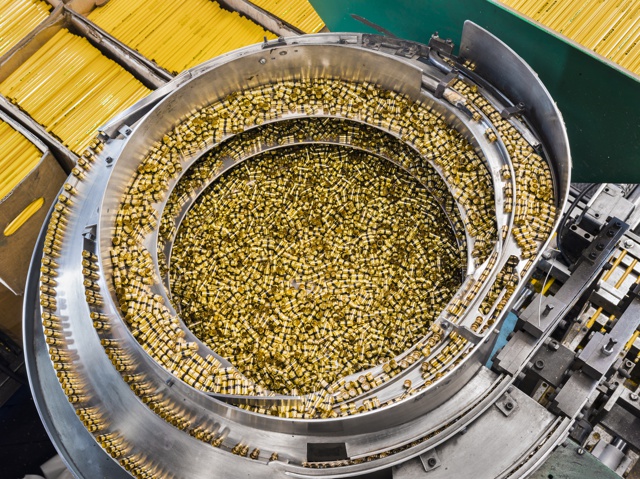
Bird's eye view of a tiered, steel vat of small metal rings that separate the wood of a pencil to its eraser. The pencil ferrules are silver and yellow in color, and along the rim tier of the vat are stacked more neatly and upright in comparison to those that lay in the bowl of the vat.
Made in America: The Industrial Photography of Christopher Payne
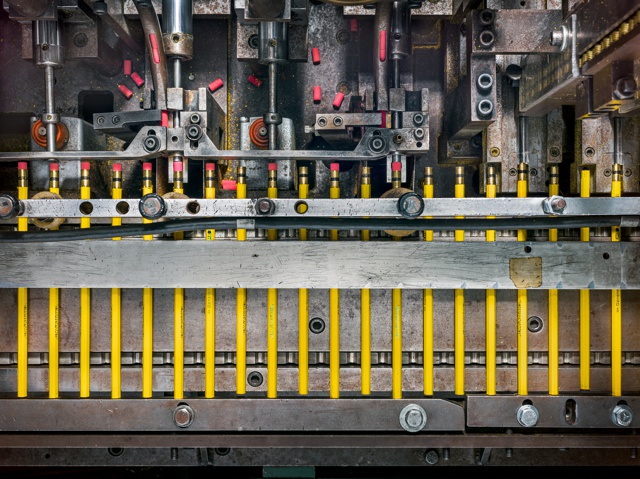
A row of identical bright yellow #2 wooden pencils lines the entire photograph. They are completely framed by metal machinery. The top left and top center of the photograph features a scattering of small, pink cylindrical eraser heads.
Made in America: The Industrial Photography of Christopher Payne
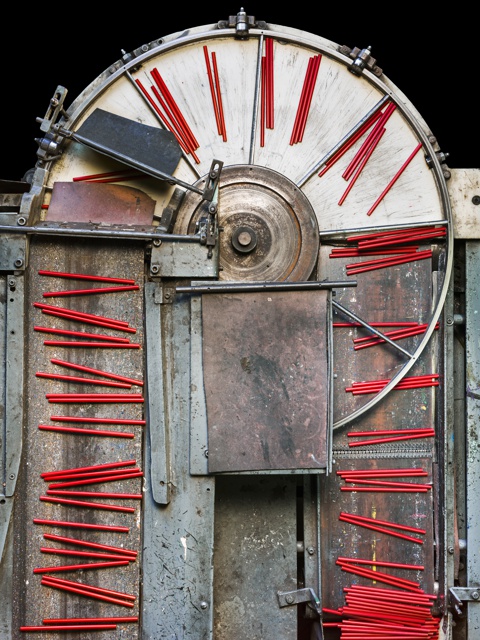
Aerial view of painted pencils drying on a conveyor belt. The red pencils are placed parallel to one another in a row along the surface of the conveyor belt's curving path. Some of the red pencils appear to be touching, while others are more spread apart.
Made in America: The Industrial Photography of Christopher Payne
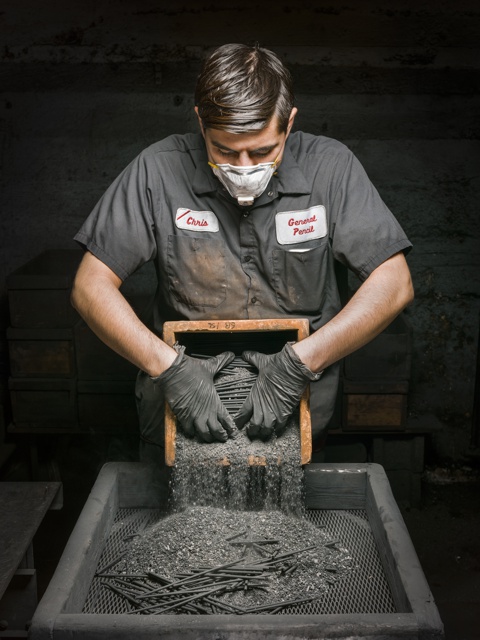
Centered and brightly lit against a black background is an individual in a KN95 mask and black rubber gloves looking down at a grate of charcoal sticks and dust. With both hands they firmly hold a wooden box to their torso, gingerly emptying its contents into the steel grate below them at bottom center. They are wearing a dark grey worksuit with a white patch that reads “General Pencils” in red script on the left side of their chest, while an identical white patch to their right reads “Chris” in red script.
Made in America: The Industrial Photography of Christopher Payne
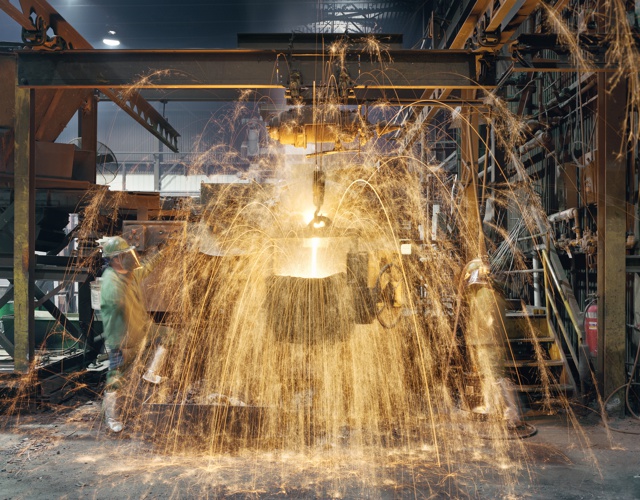
The background shows various horizontal and vertical metal beams within a warehouse. They are darkened by a center explosion of sparkling light that cascades in a fountain shape from a barely visible crucible. A man in a green helmet, black face shield, and reflective boots stands to the left of the explosion, operating the machinery.
Made in America: The Industrial Photography of Christopher Payne
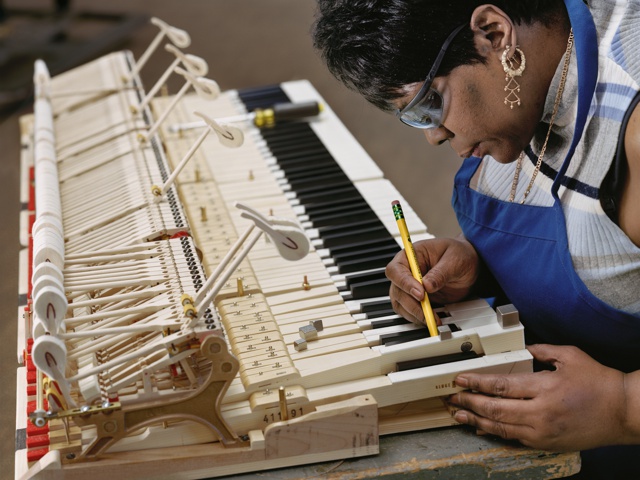
A Black woman wearing clear protective goggles, a striped shirt, and a dark blue apron holds a wooden #2 pencil in her right hand. Her left hand rests in the foreground of the photograph against a row of piano keys set in a light wooden frame. A screwdriver with a yellow and black handle is placed on top of the keys and is visible, although blurred, in the distance.
Made in America: The Industrial Photography of Christopher Payne
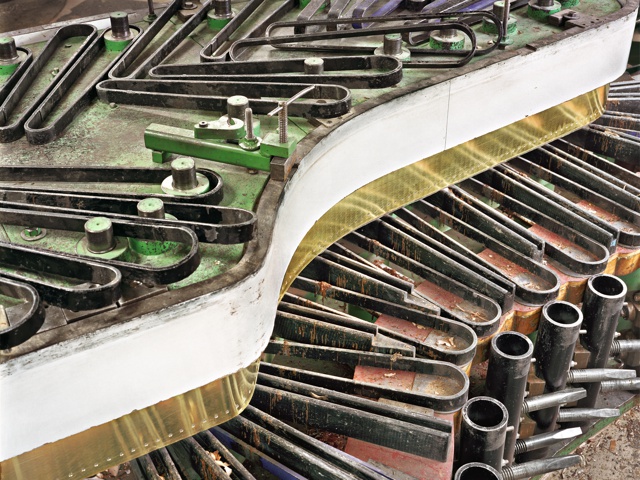
Bisecting the image is an elongated s-shape strip of ivory material with gold lining that enters frame from bottom right and snakes diagonally to the top left. The top half of the photo is consumed by an arrangement of black steel rods in the shape of large paperclips held in place by circular steel bolts. The bottom half of the photo shows a partial view of the same oval-shaped steel rods.
Made in America: The Industrial Photography of Christopher Payne
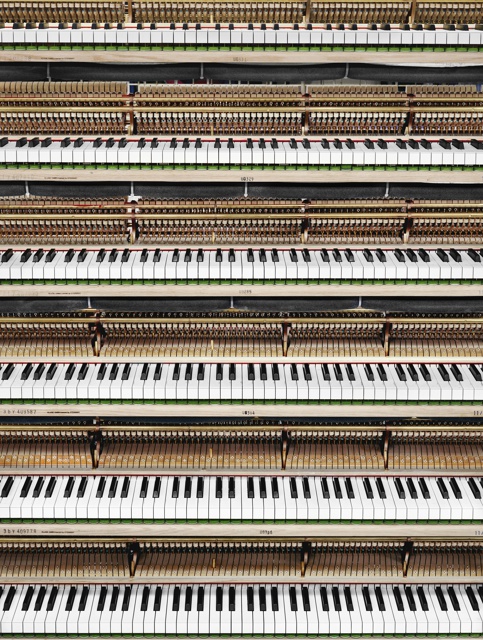
Close up of six vertically ascending rows of piano keyboards stacked on top of each other like stripes that ascend from foreground to background. The light wooden attachments of the black and ivory keys, often hidden under the hood of a finished piano, are exposed to the viewer.
Made in America: The Industrial Photography of Christopher Payne
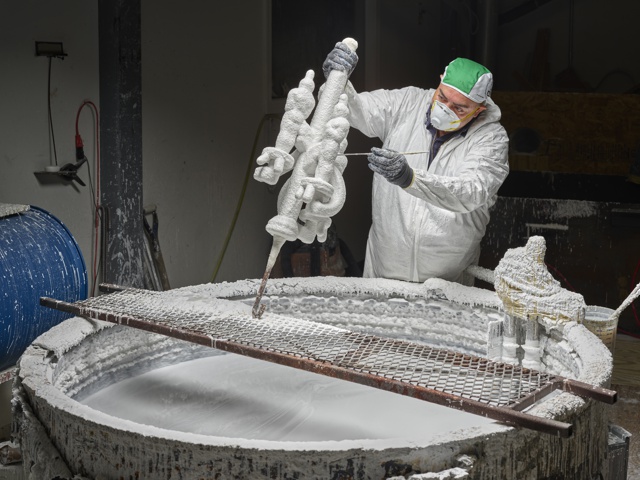
Spanning the bottom half of the photograph is a large circular tub filled with white silica, a filmy white material in liquid state. Standing over the vat to the right is an individual in a white hazmat suit, a KN95 mask, and a green and white head cap. Their eyes are focused on a large white statuette that they firmly hold on top of a rectangular grate placed over the vat, while their left hand uses a thin tool to carve small details in the statuette.
Made in America: The Industrial Photography of Christopher Payne
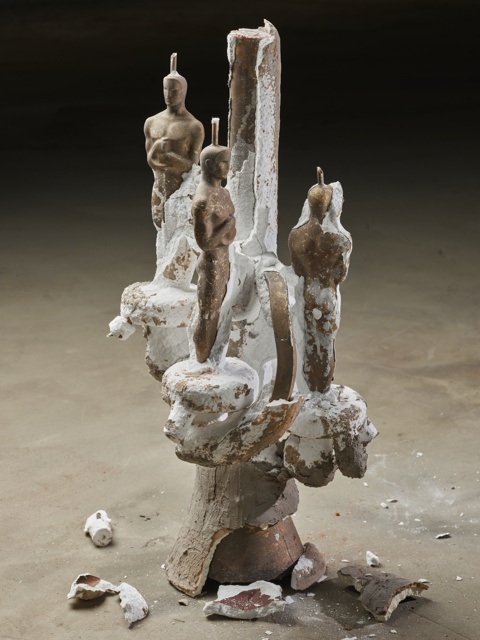
A ceramic statuette sits on a concrete floor, the background fading to black towards the top of the photo. The grey flared base of the statuette is partially cracked, and several curved pieces are scattered across the floor nearby. Three identical simplistic male-forms cascade down the side of the statuette, and a fourth cylinder at the top of the form suggests another figure will soon emerge.
Made in America: The Industrial Photography of Christopher Payne
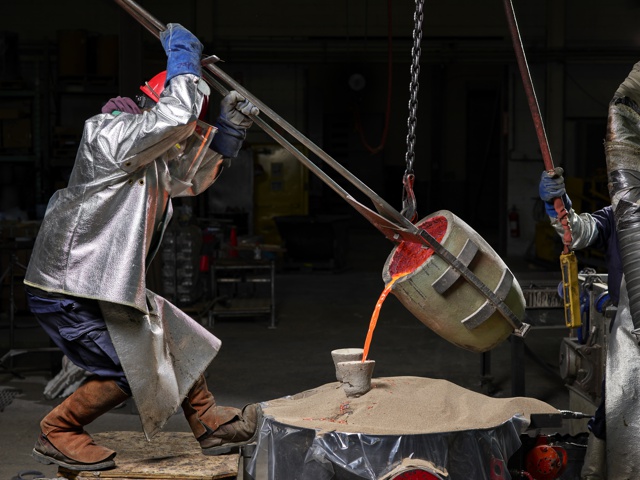
A man in a reflective apron, red helmet, and clear face guard stands with his right foot mounted on a wooden board and left foot propped up on a tall mound. With his hands raised above his head, he grasps two long metal poles to tip a container downward. From the oval-shaped container flows a bright orange stream of molten bronze into a hollow vessel placed on top of the mound.
Made in America: The Industrial Photography of Christopher Payne
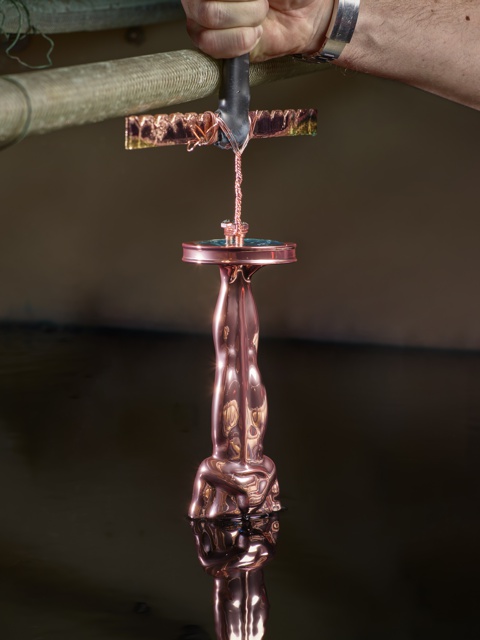
A simple male figurine dangles upside down while being coated in a rich, metallic copper mixture. The feet of the figure are fused to a circular base that, moving upwards, is attached to a thin copper wire and an additional strip of metal. A partial view of a fist is seen at the top center of the photograph, white-knuckled as it grasps a black bar to raise the figure from the mixture.
Made in America: The Industrial Photography of Christopher Payne
Worker sitting on a chair at left working with their hands on a massive rocket head looming above them. The rocket tip lies horizontal in an open, yellow room with gray floors, the shape starting off thick on the right and tapering to a point at the left above the worker. A variety of colorful cords attach from the tip of the rocket to the body of the structure.
Made in America: The Industrial Photography of Christopher Payne
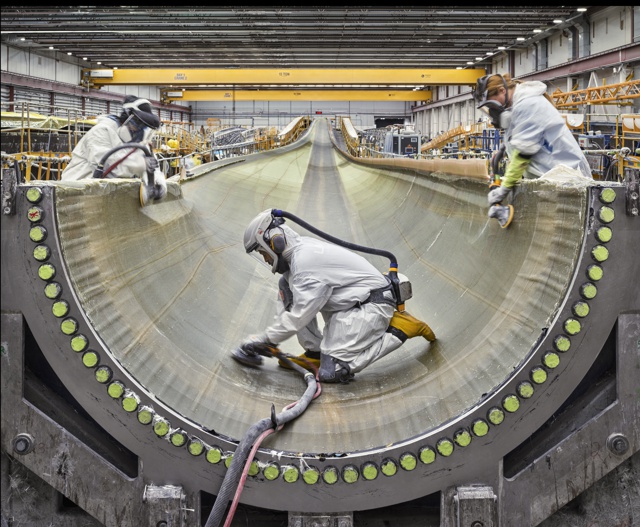
A slightly blurred action shot of a factory worker in a white hazmat suit as they crouch in profile sanding the inside of a wind turbine blade, itself appearing as a very long tube cut in half and engulfing the worker. There are two other factory workers on the outside edge of the blade in standing positions leaning over to sand, framing the central worker.
Made in America: The Industrial Photography of Christopher Payne
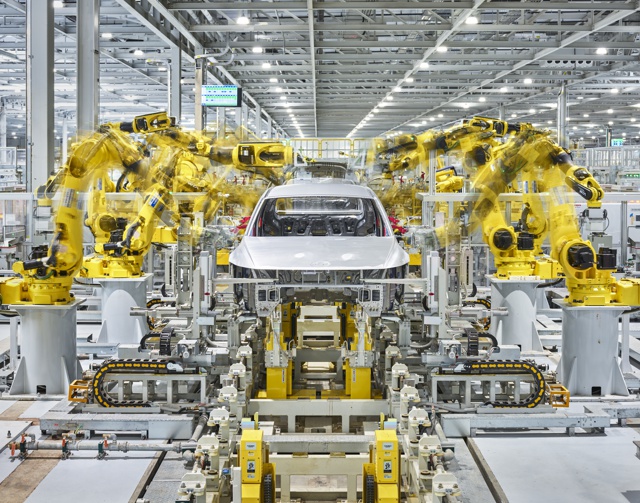
A silvery white, semi-matte exterior body of a car sits in a bulky exposed assembly belt. The car faces the viewer, completely surrounded on each side by a massive swarm of bright yellow robotic arm-like machines, blurred by the speed of their movement. The machines attack the car hood’s perimeter at various angles. Behind the car, the hood of the car behind it peeks out, as do the rows of robotic arms. The sprawling silver ceiling of the warehouse looms above and the car appears small in comparison.
Made in America: The Industrial Photography of Christopher Payne
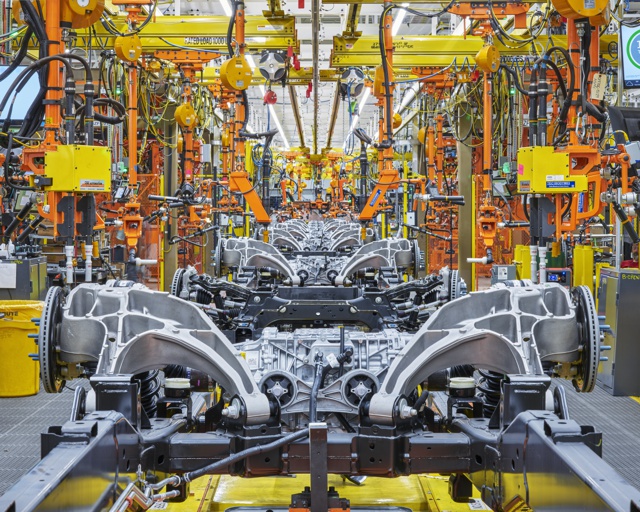
Vertically symmetrical photo of an assembly line for gray and black opaque car parts. Yellow and orange machinery surrounds the top half like a tunnel.
Made in America: The Industrial Photography of Christopher Payne
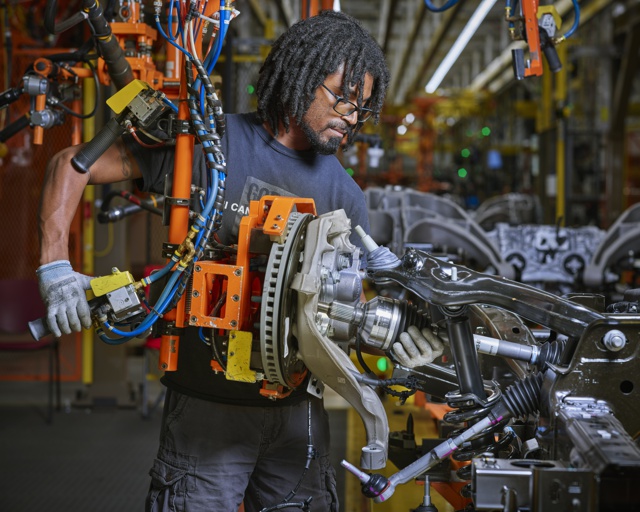
A person operating a large robotic arm reminiscent of a gas pump. The robotic arm is as large as the worker's body and is attached from above, out of the photograph's frame. The arm has orange metal parts, blue tubing emerging from overhead, a gray turbine-like wheel on the main body of the arm, and a long gray nozzle attached by a black metal frame.
Made in America: The Industrial Photography of Christopher Payne
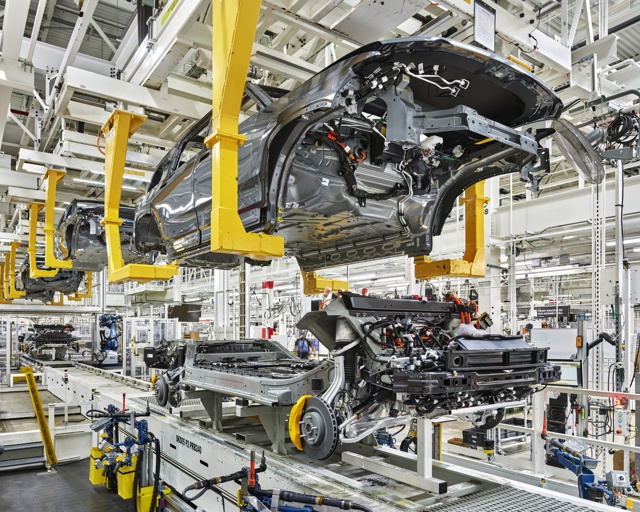
Within an impressively sterile, white steel factory, a diagonal assembly line from top left to bottom right contains gray metallic car tops that are suspended in the air with bright yellow hooks. Sitting underneath the suspended tops are the corresponding bottom halves of the cars.
Made in America: The Industrial Photography of Christopher Payne
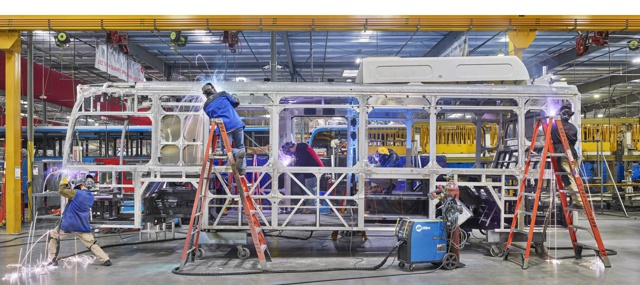
An active group of welders in casual fire-retardant garb and welding masks dispersed amongst the white metal skeleton of a city bus as flying sparks roar out of their tools.
Made in America: The Industrial Photography of Christopher Payne
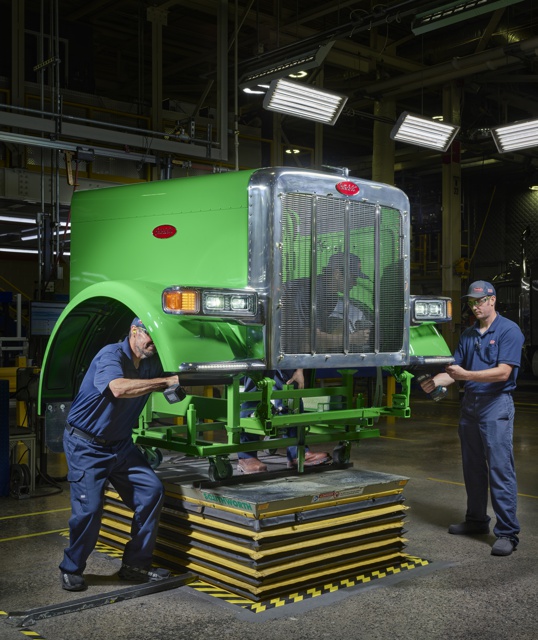
Three factory mechanics work on a neon green colored head of a truck. There is one worker on the left side of the truck's front grate and another on the right side. Visible through the grate is a third mechanic at work.
Made in America: The Industrial Photography of Christopher Payne
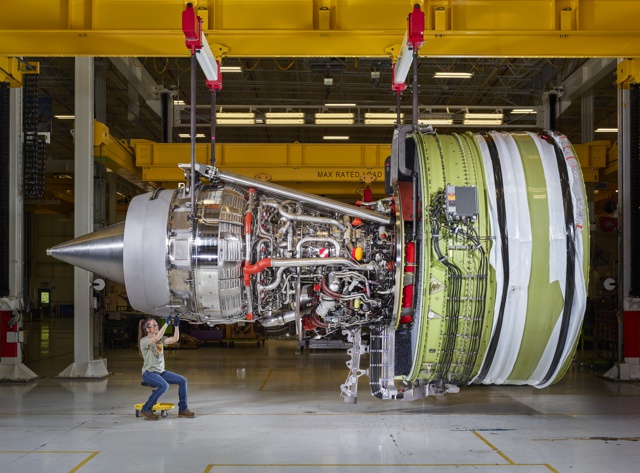
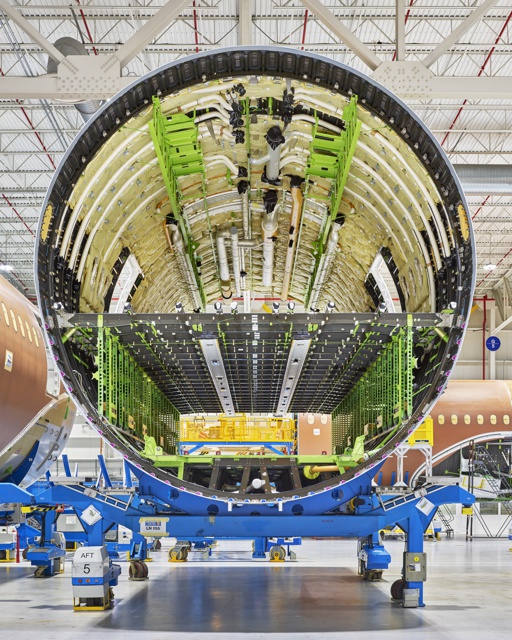
An elephantine cylindrical tube sits on top of a massive blue jack with wheels amongst other airplane fuselages in a lofty white factory. The tube appears neatly spliced open and filled with green and dark grey crosshatching metal.
Made in America: The Industrial Photography of Christopher Payne
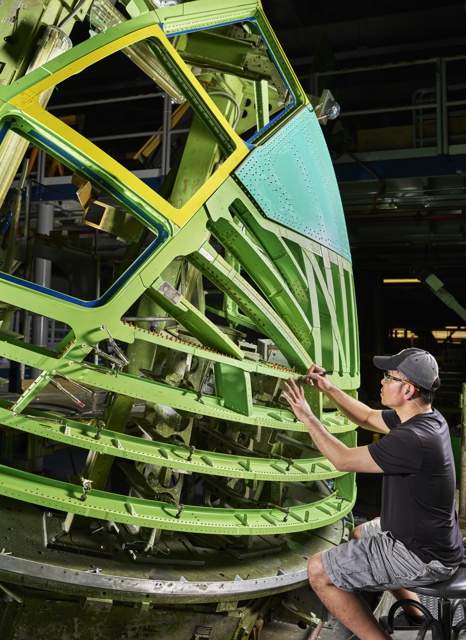
A man in a baseball hat and safety glasses sits on a work stool in profile as he reaches up to a towering green metal armature to tinker with a pen-like device.
Made in America: The Industrial Photography of Christopher Payne
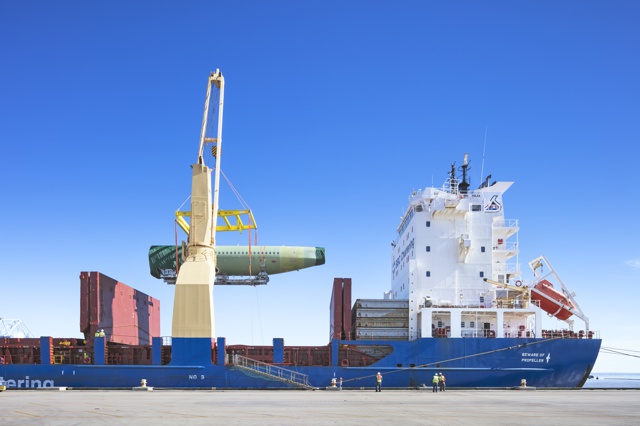
A blue and white container ship docked against a bright cloudless blue sky. Suspended over the deck from the ship's attched pale yellow crane is an entire cabin section of a commercial airplane in olive green.
Made in America: The Industrial Photography of Christopher Payne
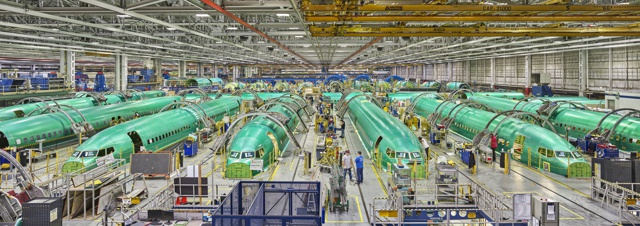
A sweeping, landscape-like scene of rows and rows of green commercial airplane fuselages half-submerged in the concrete floor of a heavily-machined but sparsely populated factory.
Made in America: The Industrial Photography of Christopher Payne
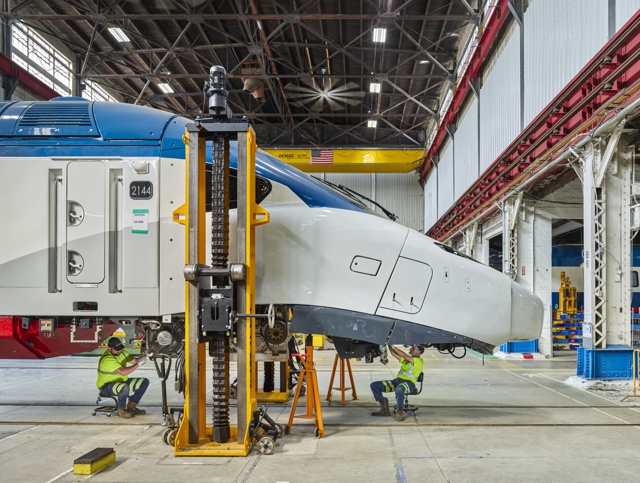
In an industrial warehouse reminiscent of an airplane hangar, two men in highlighter green shirts sit in rolling stools flanking either side of a towering yellow carjack that suspends a mammoth-sized train car above them. The men tinker with exposed wheels and wires along the underside of the train.
Made in America: The Industrial Photography of Christopher Payne
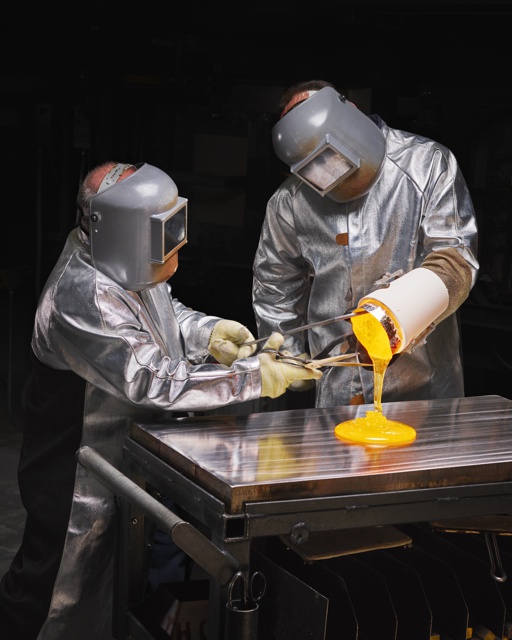
Two people wearing silver hazmat suits and welding helmets pour glowing orange glass in liquid form onto a chrome tabletop. The person on the right holds the crucible that pours out the molten glass while the person on the left cuts the glass with a pair of industrial grade scissors.
Made in America: The Industrial Photography of Christopher Payne
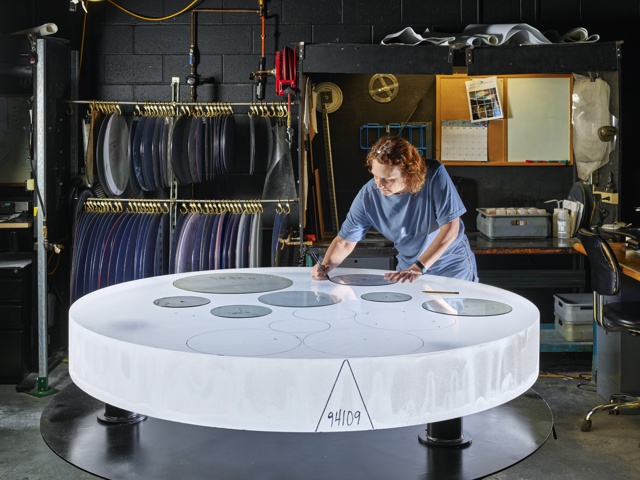
A woman dressed in a blue work uniform angles over a round luminscent white work table. She stencils various sizes of large circles onto the workstation surface. Behind her are racks of hanging circles in various sizes nearly identical to what she currently works on.
Made in America: The Industrial Photography of Christopher Payne
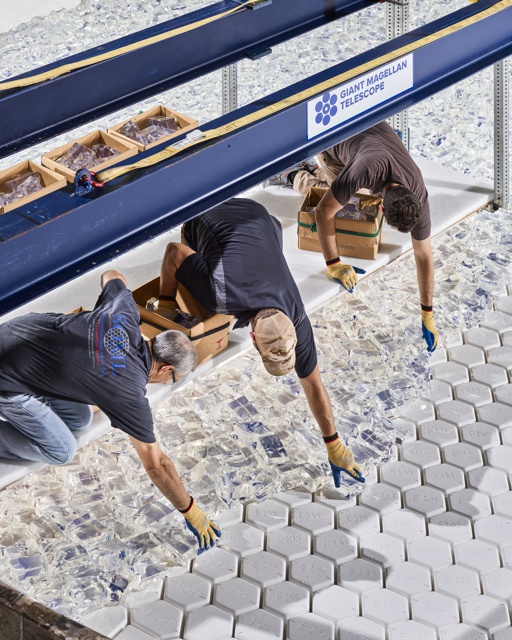
A group of three men in safety glasses and bright yellow and blue work gloves kneel off of a suspended platform, reaching down to coat a layer of chunky crystalline glass atop a swath of stone entirely grooved with a perfectly repeating hexagonal pattern.
Made in America: The Industrial Photography of Christopher Payne
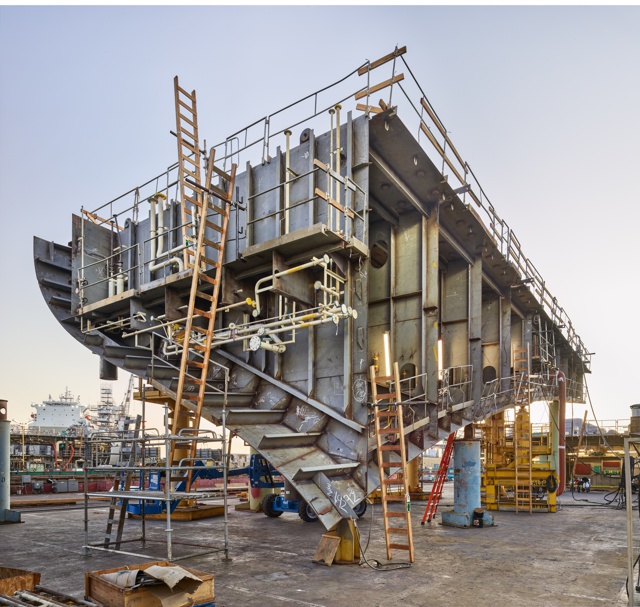
A section of a container ship shaped like a wide diamond perches atop a concrete ship yard, propped up by a teal blue jack with several yellow ladders along it's perimeter. The section of the container ship holds most of it's weight at the top of its diamond shape and elegantly curves to tapers off to a point at the bottom.
Made in America: The Industrial Photography of Christopher Payne
A cavernous, circular white metal door with a silver steering wheel at the center. Gears, bolts, and handles decorate the door’s silver and copper circumference, the entire impressively sheeny hatch perched atop a horizontal copper coil that runs the door’s diameter. Below the coil is a glimpse of a round brown metal frame that the door closes down into.
Made in America: The Industrial Photography of Christopher Payne
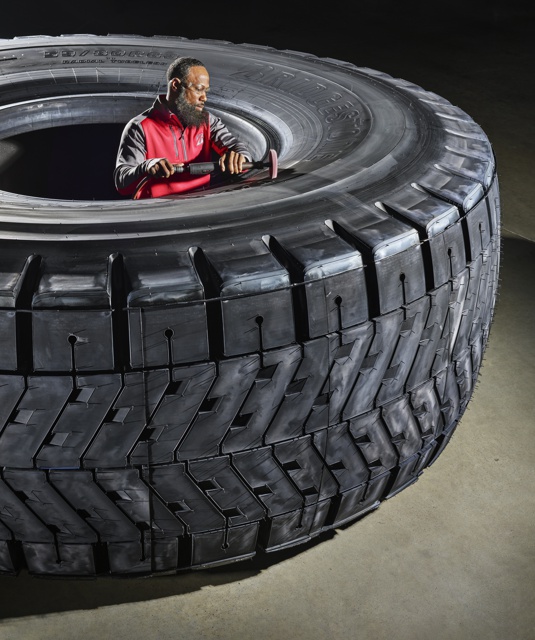
A spotlit man stands dwarfed in the center of a massive deeply-treaded black rubber tire that swallows him up to his chest. The tire casts a stark shadow from the spotlight, adding to its gargantuan quality. He holds in concentration a rod tipped with a cylindrical sponge polishing the surface of the tire.
Made in America: The Industrial Photography of Christopher Payne
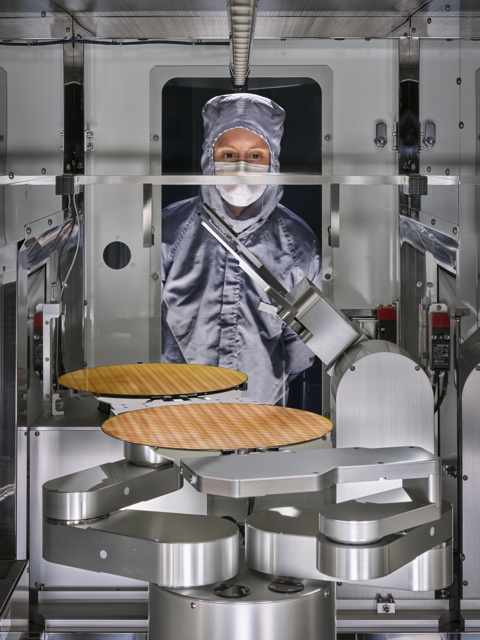
A fully-clothed and head-covered worker with only eyes exposed peers towards the viewer through a window into a small metallic room, examining armature below. Two flat, golden brown wafers shaped like flat disks and the size of the worker's head sit on the armature amid being pressed.
Made in America: The Industrial Photography of Christopher Payne
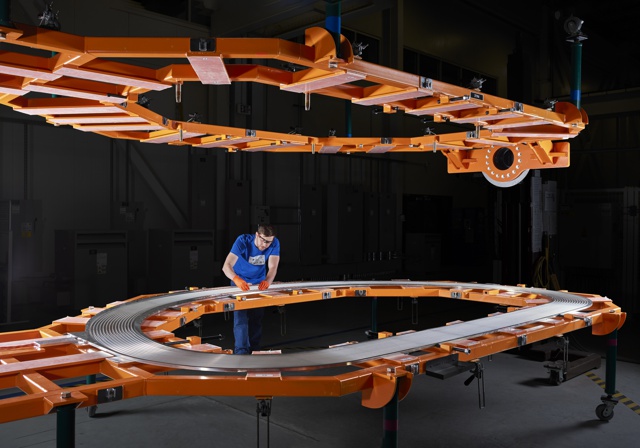
A worker stands with two large, metal, orange frames shaped like racetracks in a room. One of the frames is suspended from above and the other sits underneath it, table-like and on raised wheels. The worker stands over and interacts with the bottom frame.
Made in America: The Industrial Photography of Christopher Payne
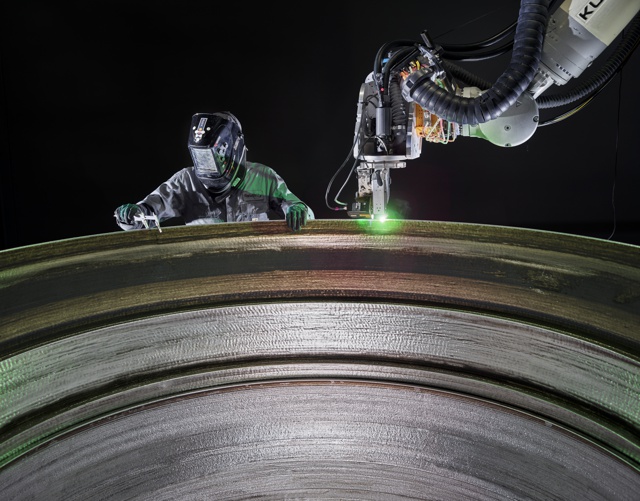
A dramatic photo of a worker in a suit and welder's helmet next to a human-sized robotic arm against a flat black background. The worker measures the width and the robotic arm touches the top of a large, shiny, spherical wall that spans more than the bottom half of the photo. A glowing green light shines where the the robotic arm and spherical wall meet.
Made in America: The Industrial Photography of Christopher Payne
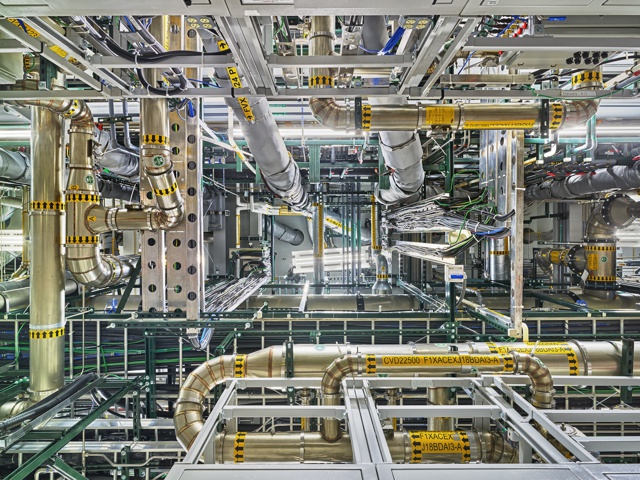
Photograph of upward view of a large industrial facility with complicated interlocking grids filled with bundles of black wires and metal piping labelled with yellow tape.
Made in America: The Industrial Photography of Christopher Payne
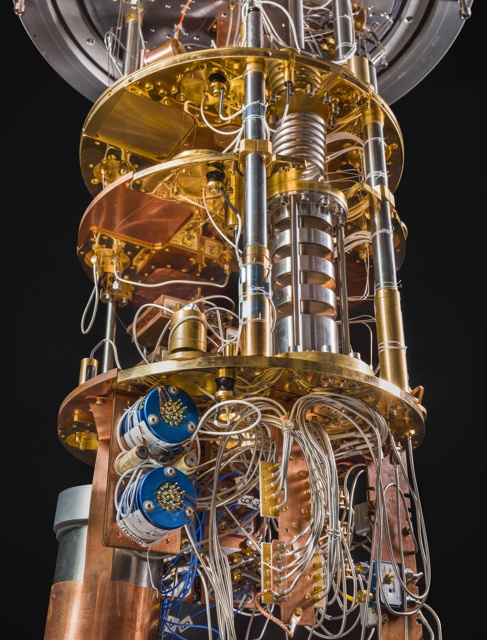
An open tower comprised of shiny metal plates, rods, and intricately-placed cords, the entire structure reminiscient of a spinal chord. There are three prominent gold and copper plates that break the tower up into relatively even horizontal sections, within each section are wires, metal rods and springs. Beneath the nearest plate is an elaborate collection of panels with exposed wiring and tubes.
Made in America: The Industrial Photography of Christopher Payne
A person in a full puffy white astronaut suit, complete with clear helmet and oxygen tank, walks on a black treadmill labeled Tuff Tread in yellow along its bottom side. The person's face is fixed in concentration as their body slants deeply forward to walk, their gloved hands assisting the trudge as they grip two black metal appendages that rise up from the treadmill to torso level.
Made in America: The Industrial Photography of Christopher Payne
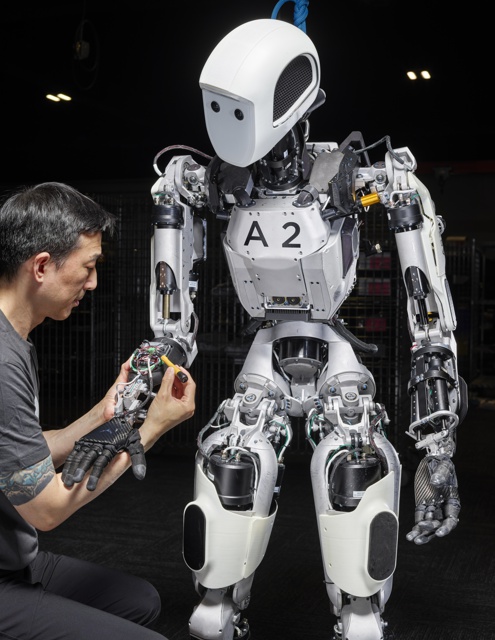
A person crouches to examine the forearm of a robot. The robot stands and has its head tilted down, as if they were watching the worker in curiosity The robot has exposed joints and white plates on the torso, legs, and around its head. On its chest reads A-2, its other hand waiting and outstretched.
Made in America: The Industrial Photography of Christopher Payne
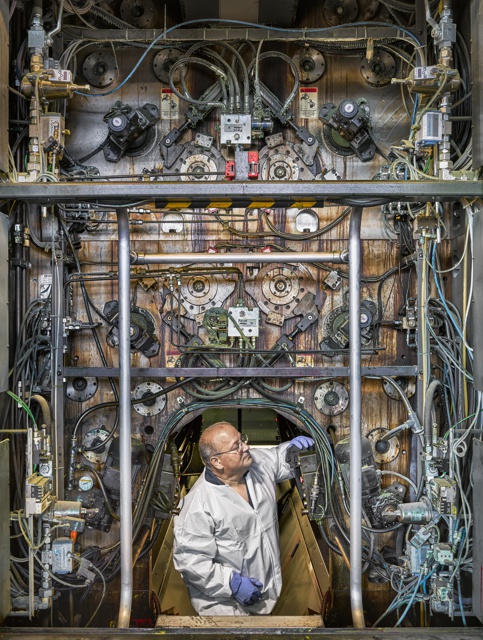
The inside of a large mechanical printing press with an arched opening at the bottom center framing a worker in white coveralls and blue plastic gloves looking up to the right. A thicket of wires snake along the opening and continue up, around, and throughout the press along with gears and switches.
Made in America: The Industrial Photography of Christopher Payne
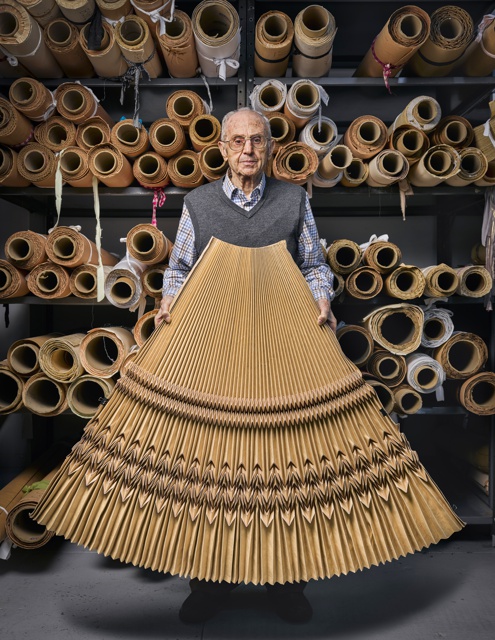
An older man in glasses, a checkered button up, and a dark grey sweater vest stands in front of shelves holding large rolls of fabric, mostly brown but some white. He holds large upside down fan of pleated fabric in front of him that is made of folded rows and diamond shapes.
Made in America: The Industrial Photography of Christopher Payne
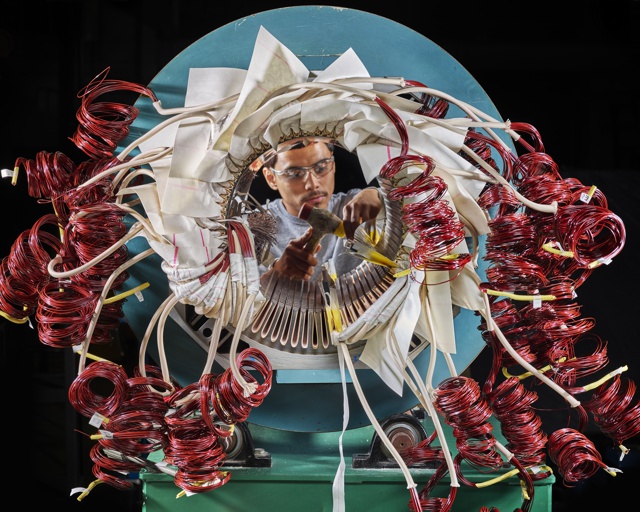
A bright turquoise circular frame sits on top of a green tabletop in front of a black background. The center of the frame is open like the letter “o” and through it there is a worker wearing safety glasses while using a hammer. The opening is surrounded by pieces of white cloth and tubes that end in thick coils of red metallic wire.
Made in America: The Industrial Photography of Christopher Payne
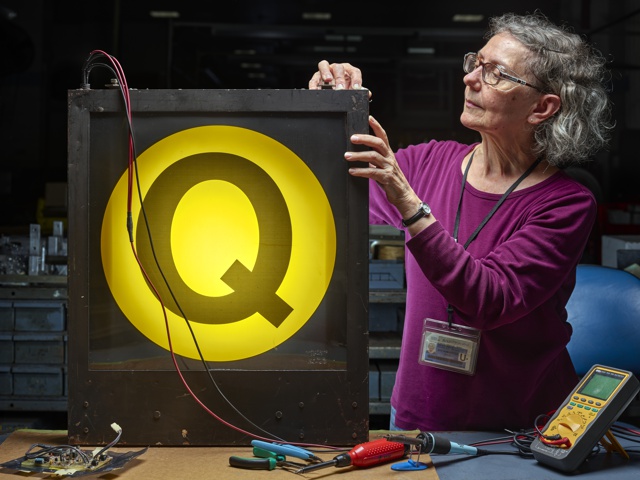
A large black box is filled with a brightly lit up yellow circle showing the letter “Q” of the NYC subway train line. An older woman with grey hair, glasses, and a purple long sleeve shirt stands to the right and is delicately touching the box. The box sits on a table at hip height and reaches past the woman’s chin, on the table are tools and two wires that connect to the top of the box.
Made in America: The Industrial Photography of Christopher Payne
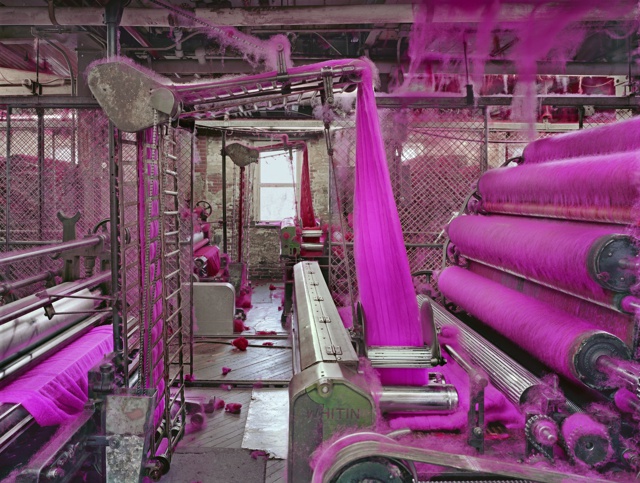
Interior of a textile manufacturing facility where bright magenta-colored fibers are being processed. The machinery is large and industrial, with multiple rollers, conveyor systems, and spindles. The joyously magenta wool moves through various stages of carding. Loose fibers are scattered all over the floor, equipment, and even hanging in the air, giving the scene a fuzzy, almost surreal look of the magenta color. The factory has brick walls, weathered floors, and analog roller devices. The off-centered natural lighting coming through a window at the back of the room enhances the saturation of the pink fibers.
Made in America: The Industrial Photography of Christopher Payne
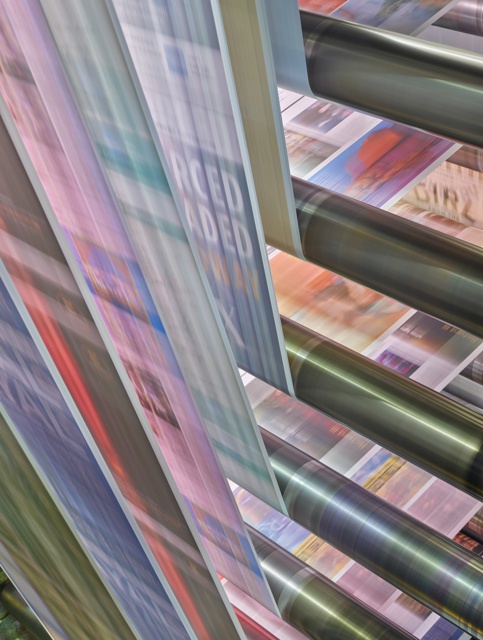
A high-speed commercial printing press in operation. Sheets of paper move rapidly through a series of rollers. The photo captures the motion blur caused by the fast movement of the printed material, which includes various pastel colors, images, and text. The high speed blur of printing appears like a cascade or waterfall of colorful paper over the left half of the photo. The rollers are metallic, cylindrical, and compactly layered at a 135 degree angle. The visible text and images are partially blurred due to the speed, but the bright colors of the full-color printing is visible.
Made in America: The Industrial Photography of Christopher Payne
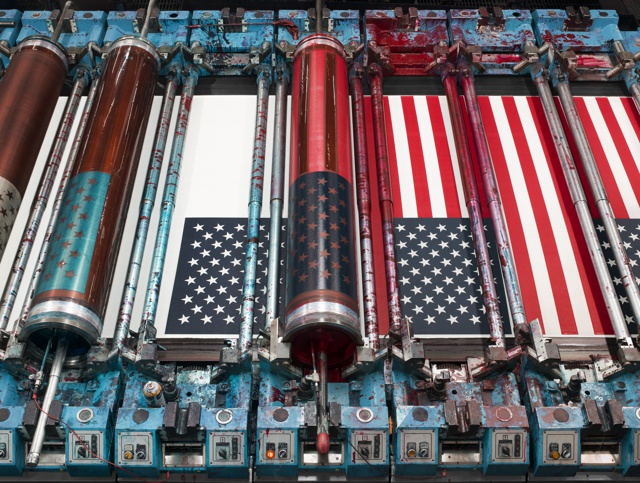
Close-up view of an industrial printing press producing American flags. The press features a series of large cylindrical rollers arranged horizontally, each involved in a different stage of the color printing process. The machine is actively printing red, white, and blue ink to form the U.S. flag pattern on paper moving beneath the rollers. The blue machine that borders the top and bottom of the photo shows visible signs of heavy use, splatters of ink and wear. The mechanism includes numerous metal rods, clamps, and control switches.
Made in America: The Industrial Photography of Christopher Payne
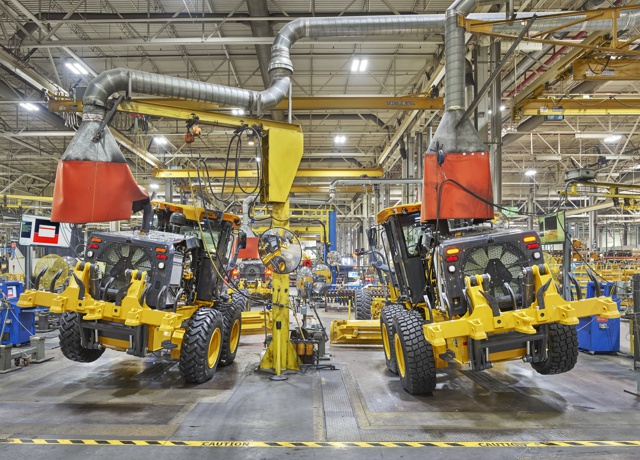
Interior of a manufacturing facility for construction vehicles. The focus is on two large, yellow motor vehicles in the calibration stage of assembly. The vehicles being calibrated are typically used in construction for digging and lifting. In the photo, hydraulic arms on a centrally located yellow poll are lifting and tilting the vehicles. Large orange hoods and silver ducting are positioned over each machine, as part of a ventilation system. There is yellow and black CAUTION tape along the factory floor in the foreground of the photo. Overhead are suspended yellow steel beams hang from the beige ceiling. Accents of bright blue workstations and steel polls speckle the mostly yellow environment.
Made in America: The Industrial Photography of Christopher Payne
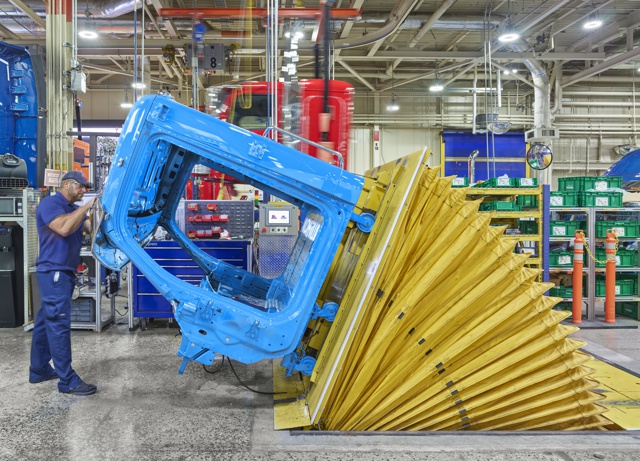
A factory worker holds up a tilted blue vehicular chassis resting on a yellow accordian-like manufacturing equipment. The worker's upper body is slightly blurred, suggesting motion when the photograph was captured.
Made in America: The Industrial Photography of Christopher Payne
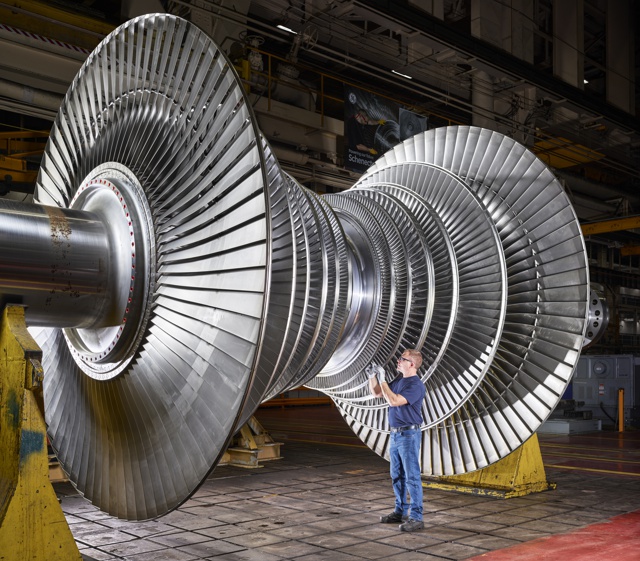
A large silver hourglass-shaped turbine rotor, turned horiztonal and with a ring of brown rust patches on the lefthand shaft. A person standing in front of the rotor's center blades holds pliers to the structure, the turbine itself is over twice the height of the worker.
Made in America: The Industrial Photography of Christopher Payne
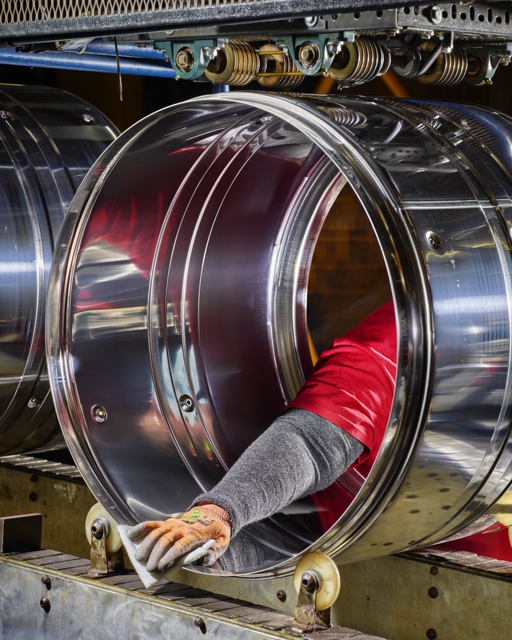
The arm of a person polishing the inside of a large, cylindrical stainless steel dryer drum on an assembly line. The dryer drum with it's mirror-like surface is the dominant central subject of the photo. A person who is not visible, except for an arm, is wearing a short sleeved bright red T-shirt over a long sleeved grey shirt, and bright orange work gloves. The arm is reaching into the cylinder with a white folded cloth polishing the interior surface of the drum. The assembly line includes heavy-duty mechanical parts, wheels, and metal framework above and below with another steel drum partially visible next on the assembly line.
Made in America: The Industrial Photography of Christopher Payne
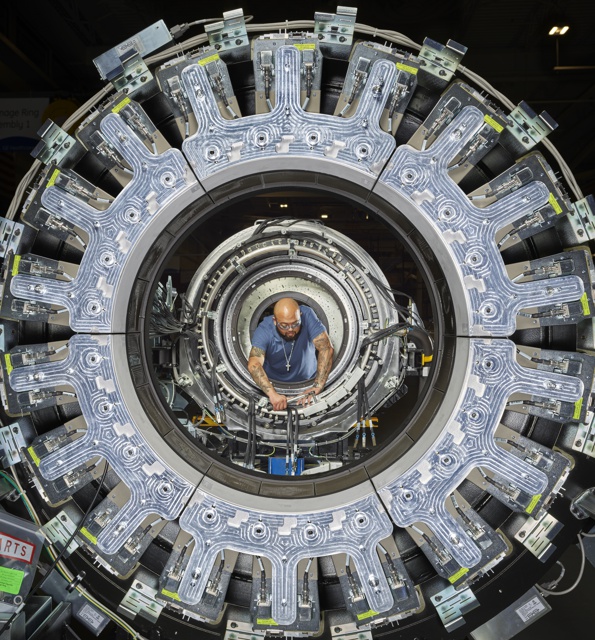
At the center of the image is a factory worker encircled by various mechanical and manufacturing equipment creating a kaleidoscopic visual. The different parts create rings, each with unique patterns and details. The outer most rings have intricate wiring and metal components creating a segmented pattern resembling rays.
Made in America: The Industrial Photography of Christopher Payne
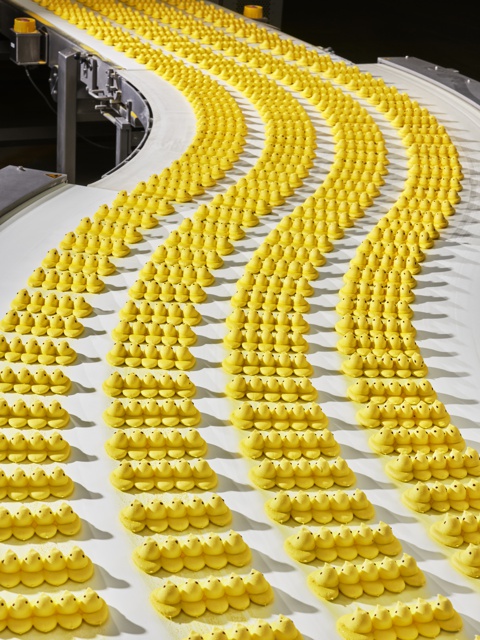
Aerial view of an ess-curved white conveyor belt with four evenly spaced columns of yellow marshmallow Peeps chicks. Each packaged column is made of five peeps attached in a row facing the back of the belt. The contrast between the yellow peeps and the white belt creates a striped ribbon effect.
Made in America: The Industrial Photography of Christopher Payne
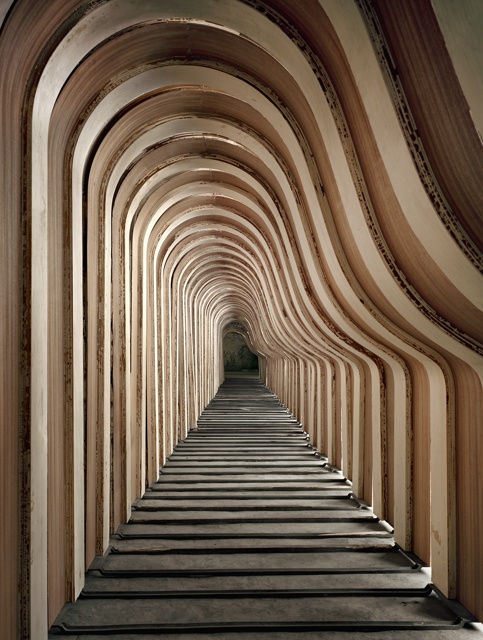
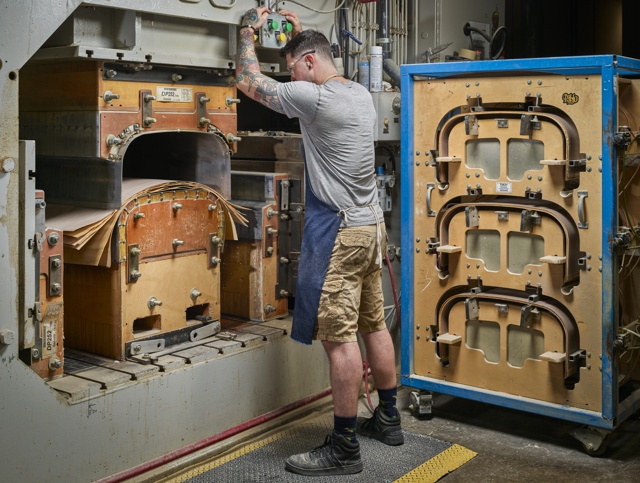
A worker standing in front of a machine press bending plywood into an upside-down u-shape. The worker’s arms are raised above their head, their hands rest on a control panel with three round buttons at the top. To the right a cart almost as tall as the worker stores curved and bent pieces of wood.
Made in America: The Industrial Photography of Christopher Payne
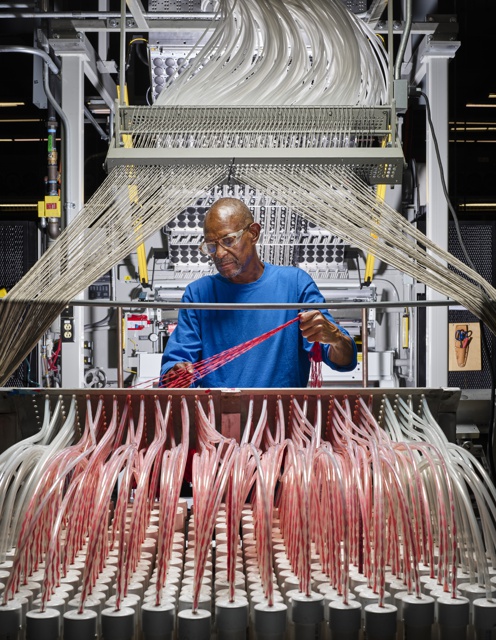
An elderly man of dark complexion wearing safety glasses and a bright blue T-shirt. He is handling a bundle of red strands of fabric. His facial expression is focused. Above and below him are hundreds of white tubes feeding into the carpet making machinery, framing him in a soft and swerving archway before feeding into the machine below. Behind him is a glowing silver complex of metal rods and wires that make up another section of the tufter.
Made in America: The Industrial Photography of Christopher Payne
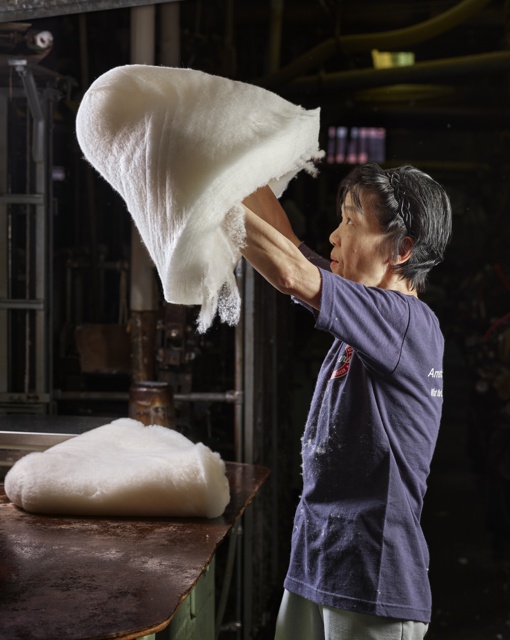
A woman dressed in a blue work uniform is standing with her hands raised and in motion. Her hands are inside a soft and fibrous material that appears to be in air.
Made in America: The Industrial Photography of Christopher Payne
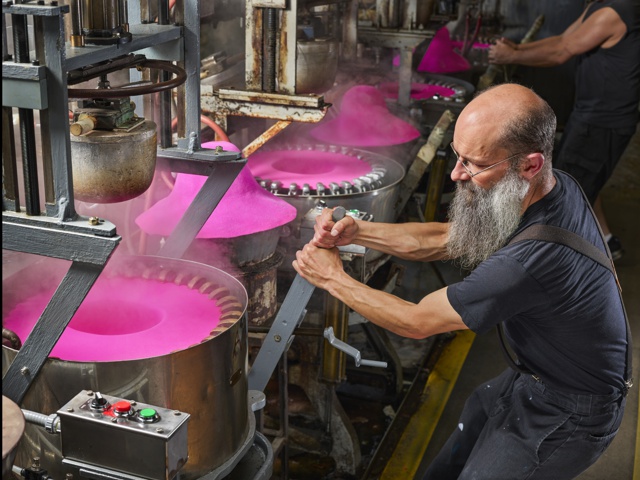
Factory worker operating a lever in front of a round basin where pink hats are being manufactured. A bulbous metal component above the basin stamp and shape the crown of each hat. The hat's brim are secured with metal clamps during processing. Multiple equipments are side by side to each other, another worker is partially pictured in the background. Mechanical controls are visible on the left side. Wisps of smoke rise from hats either from coloring or its base material creating a dynamic and industrial atmosphere to the scene.
Made in America: The Industrial Photography of Christopher Payne
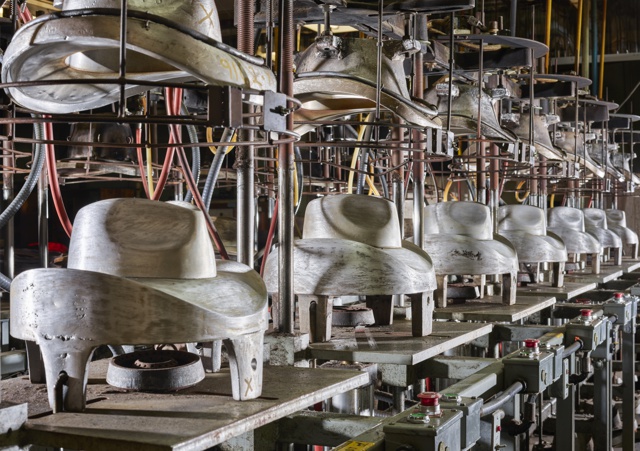
Hat molds photographed from a two-point perspective showing a concave shape on the top and a solid form at the bottom. Although no actual hats are present, the device appears to be used for pressing material to shape them. Surrounding wires and repeating components including manufacturing start-stop buttons form a visual pattern. The elements on the left appear closer to the frame. As it recedes to the right, depth and perspective is emphasized.
Made in America: The Industrial Photography of Christopher Payne
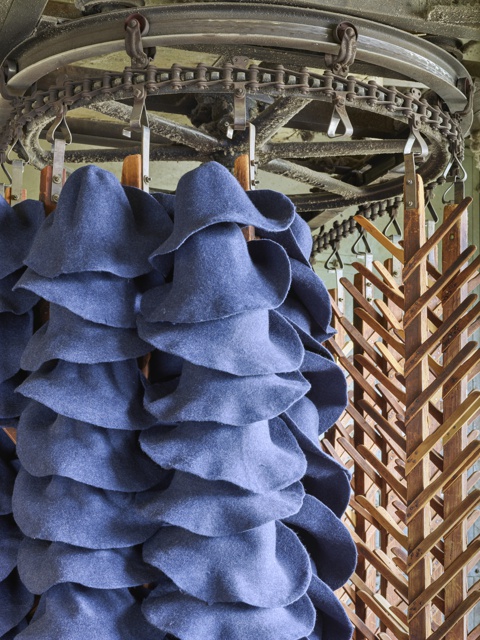
Blue hats made of a felt-like material hang from wooden fixtures attached to a rotating carousel. Only the left side of the carousel rack hold hats while the right portion of the image remains empty. It creates a visual contrast of repeating patterns of blue brims on the left and empty wooden fixtures with tilted rods on the right.
Made in America: The Industrial Photography of Christopher Payne
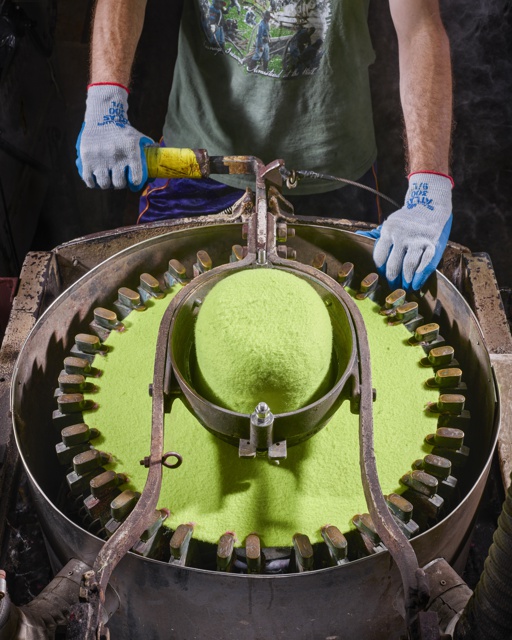
A partially photographed factory worker is engaged in the production of a yellow hat. The worker wears grey gloves with blue grips and is holding onto a yellow lever while the hat is secured in rustic metal clamps. The crown of the hat is held by a circular apparatus connected to the side of the round machinery. Multiple smaller clamps support the crown as the worker performs a specific manufacturing move, capturing the worker in a stationary moment rather than in motion.
Made in America: The Industrial Photography of Christopher Payne
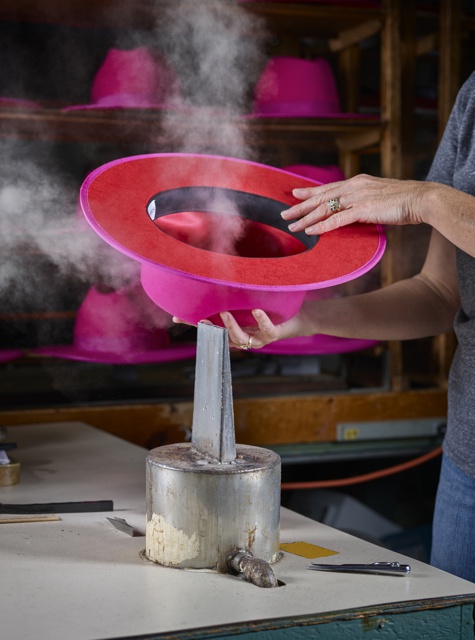
Pink hat with red brim being steamed by a metal equipment. Steam can be visually seen on the upper-left corners of the image. On the blurred background, more of the same hats are present.
Made in America: The Industrial Photography of Christopher Payne
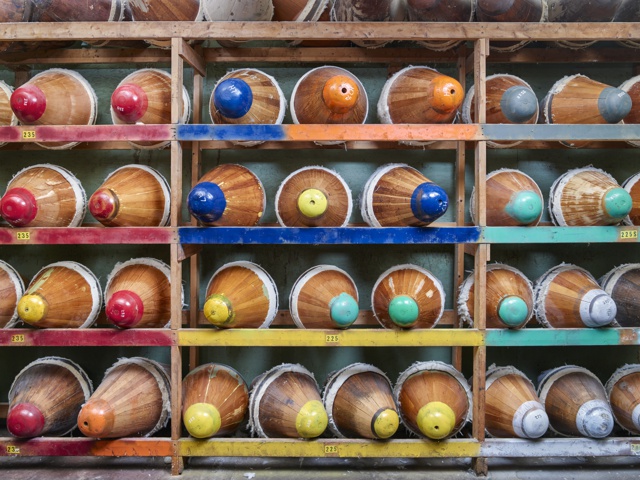
A close-up of an open vertical rack housing wooden cones lying on their side, their vibrant, cheerfully-colored tips face the viewer and their colored rims visible at their back end. The colors range from dark blue, butter yellow, carmine red, bright aqua. The image evokes that of the tips of colored pencils, grouped together by color, tips facing the viewer.